UK Casinos That Accept E-Cheques: What to Check
E-cheque availability can vary by account, while deposit and withdrawal routes, limits and costs may differ.
 Available in GB

Table of Contents
- Check the cashier before you count on an e-cheque
- Top online casinos in the UK
- Deposits and withdrawals may not follow the same route
- Fast deposits do not guarantee fast payouts
- Deposit minimums and limits depend on the payment route
- Debit cards are an alternative, with an important UK restriction
- Other payment options have their own trade-offs
- Check the full cost, not just the visible fee
- Using one account consistently can reduce avoidable friction
- Confirm the account currency before depositing
- Set a financial limit before making a first deposit
Check the cashier before you count on an e-cheque
If you are looking for UK casinos that accept e-cheque deposits, treat the cashier as the deciding point, not a payment logo on a review page. Payment options can differ from one site to another, and a method mentioned in general information may not be available to every customer when they sign in. I would not put a casino on a shortlist as an e-cheque option unless the method actually appears in its current cashier.
That distinction matters because a payment page can sound more definite than it is. A list of familiar payment brands does not establish that every product under those brands is accepted, or that the same choices appear for every account. A specialist casino-payment review, for instance, lists Visa and Mastercard, but current UK availability and whether a particular card product is eligible still need checking in the cashier. A logo is a starting clue. It is not a promise.
E-cheque searches can create the same trap. A page may use the term in a heading, mention it alongside other payment methods, or repeat an old description. None of that tells you what you can select now. I would be cautious about any “best” or “top” list that names casinos as confirmed e-cheque choices without showing that the option is available in the live payment menu. The label may attract attention; the cashier is where the actual choice becomes clear.
When checking, sign in to the account you intend to use and open the deposit section. Look for the method by name, rather than assuming it sits under a general bank or cheque category. If the cashier shows a payment option with a similar label, read its details before proceeding. Names can be easy to mistake, and a familiar-sounding option is not automatically the same thing as an e-cheque.
Casinos That Accept Entropay in the UK: What to Check
The same check applies to cards. Even where a specialist review lists Visa or Mastercard, that does not settle whether the casino currently accepts the card for a UK customer, or whether the specific card product is eligible. Check the cashier’s displayed options and any accompanying terms. If the option is absent, or the wording leaves you unsure, ask the operator to clarify before you try to pay. Guesswork at the payment screen is a poor way to start.
I have learned not to treat a page that says “easy deposits” as a substitute for checking what the account can actually use. “Available” can mean that a method exists somewhere in the operator’s payment range; it does not necessarily mean it is available to you, in your location, for your account, at that moment. The cashier is more useful than a broad promise because it shows the choices presented for the transaction you are about to make.
It is also worth checking the operator’s status before opening an account for real-money play. In the UK, remote gambling licensees serving the market must hold the relevant Gambling Commission licence. That does not confirm a particular payment method, but it gives you a basic legitimacy check before you spend time comparing cashiers. Keep the two questions separate: is the operator authorised for the market, and does its cashier offer the payment route you want? One answer cannot stand in for the other.
If you are comparing online casinos that appear to accept e-cheque, save yourself the effort of ranking them until you have checked the live payment menu. A result saying “e-cheque casinos UK” is not enough on its own. Look for clear, current wording from the operator, then confirm it in your own account. If the method is not there, do not infer acceptance from an old page, a third-party list, or a vaguely similar bank-payment label.
This is not the exciting part of choosing a casino. It is the bit that prevents a search result from turning into an assumption. If e-cheque is the method you specifically want, make that a pass-or-fail check before you deposit: find the exact option in the current cashier, confirm it applies to your account, and only then decide whether the site is worth considering. A clean answer beats a polished payment page. Check first.
Do
- Sign in to your account and check the live cashier
- Search for the method by its specific name
- Verify the operator holds a Gambling Commission licence
Don’t
- Rely on payment logos on review pages
- Assume a general “easy deposits” claim is a promise
- Infer acceptance from old pages or third-party lists
Top online casinos in the UK
- SpinFormulaBonus: 550% Up To £15,000 + 550 FS · Payout speed: 1-3 business days
- EvoSpinBonus: 125% up to €2500 + 125 Free Spins · Payout speed: 1-3 business days
- BritsinoBonus: Welcome Package – Get your £2,200 + 2,000 FS · Payout speed: 1-3 business days
- SlotoSportBonus: 500% up to £ 10 200+ 777 FS · Payout speed: 1-3 business days
- DieselwinBonus: Welcome Pack 250% up to £4000 + 200 FS · Payout speed: 1-3 business days
- NightLuckBonus: Welcome Pack + 805% Up To 6400€ + 280 FS · Payout speed: 1-3 business days
Deposits and withdrawals may not follow the same route
A deposit is only one half of a payment arrangement. If you are looking at an e-cheque online casino in the UK, do not assume that the route you use to put money in will automatically be offered for taking money out. The cashier’s withdrawal instructions matter just as much as its deposit screen.
UK anti-money laundering rules usually require a payout to go back to the original payment source. In practice, that means a casino may treat the source of your deposit as relevant when arranging a withdrawal, rather than letting you choose any destination you like. The exact options can depend on the account and payment route, so check the withdrawal information before you build a plan around a particular method.
I used to look only at the deposit button. That was half the picture. If a method appears on the deposit page, it tells you that the casino may accept funds through that route; it does not, by itself, explain how a later payout will be handled. For an e-cheque online casino site in the UK, that distinction is worth checking before you send money, not after you request a withdrawal.
What “back to the original source” means
Closed-loop rules are the basic idea to keep in mind: funds commonly return through the source used to deposit them. This is tied to anti-money laundering controls, not a promise that every payment method follows an identical process. A casino may give instructions about how the payout is routed, and those instructions should take priority over assumptions based on the deposit screen.
Casinos That Accept Ethereum in the UK: Payment Guide
Before depositing, look for the cashier’s withdrawal guidance and the payment terms. If the wording is unclear, ask the operator how withdrawals are handled for that specific route. It is better to get a direct answer than to guess that an e-cheque deposit means an e-cheque payout. The relevant question is not merely whether an e-cheque can be used to fund an account, but whether the operator explains how funds are returned after a withdrawal request.
That distinction can matter even if the deposit itself appears straightforward. A payment method can have one role when money enters an account and a different role when money leaves it. I would not treat a method label on a cashier page as a complete description of the payout process.
Approval is part of the withdrawal process
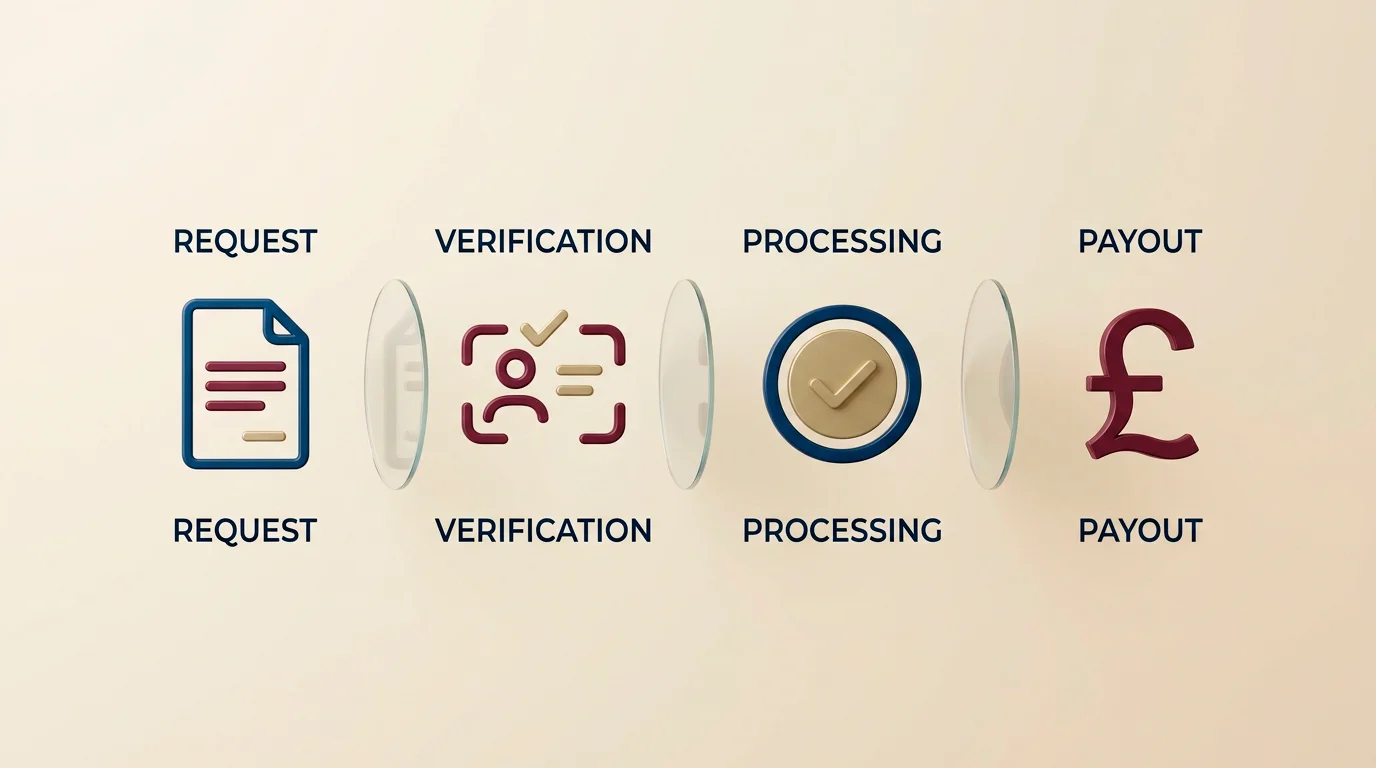
A withdrawal request may not move directly from your casino balance to your bank or payment account. The casino has an internal approval process, and that can affect how long the request takes. A specialist casino review notes that first withdrawals can take longer while verification is completed. That is a useful reminder, but it is not a fixed timetable for every operator or account.
The point is simple: a request being submitted is not the same as a payout being approved. The operator may need to complete checks before releasing funds, particularly when it is the first withdrawal. If you have not finished the required account verification, allow for the possibility that the casino will need to deal with that before processing the payout.
First withdrawals can take longer than subsequent ones while the casino completes necessary account verification checks.
KYC checks can feel like an irritating extra step when you are waiting for money, but they are part of the process rather than evidence that a particular payment route has failed. Read the operator’s instructions and respond to requests through the account’s official channels. Avoid relying on a deposit confirmation as proof that every later check has already been completed.
Questions worth settling before you deposit
For someone comparing e-cheque online casino sites in the UK, I would separate three things: whether the cashier lists the method for deposits, what the operator says about returning funds, and whether your account has completed the checks needed for a withdrawal. Those are related, but they are not interchangeable.
Check whether the withdrawal terms say that funds go back to the original source. Look for any explanation of what happens if that route cannot receive a payout, and whether the operator may ask for further verification. If the terms do not answer the question, contact customer support before making a deposit and keep the reply. A clear answer is more useful than a broad claim that a cashier is “easy” or “simple”.
There is no reason to assume that every casino handles an e-cheque withdrawal in the same way. The method’s presence in a deposit menu does not confirm its payout role, and the casino’s approval process remains a separate step. I would rather pause and establish the route than discover the uncertainty after a withdrawal request is pending.
One more thing: do not read a longer first withdrawal as proof that the casino has changed the payment route. Approval and verification can affect processing independently of how the original deposit was made. Keep the cashier guidance in view, follow the operator’s instructions, and distinguish the payment path from the checks required to release a payout.
That is the part I once skipped. Don’t skip it.
Fast deposits do not guarantee fast payouts
A deposit can appear in your casino balance before you have time to put your phone down. That is only one half of the timing story. Getting money into an account and getting an approved withdrawal back out are separate processes, so a quick deposit tells you very little about how quickly a payout will arrive.
Tether Casinos in the UK: What Payment Pages Verify
I used to treat the cashier’s deposit options as a kind of speed promise. That was a mistake. A payment method can send funds in promptly, while a withdrawal still waits for the casino to review it and release it. The two transactions may involve different steps, even when they are attached to the same account. Fast in. Not necessarily out.
That distinction matters when you are looking at e-cheque online casinos in the UK. A payment label, or a general claim that a casino has quick banking, cannot tell you how long an e-cheque deposit or withdrawal will take. The processing time for that specific route needs to be stated by the casino and checked against its current cashier information. Without that, it is better not to assume that the payment will move at the speed of a card deposit or a different bank service.
The deposit clock is not the payout clock
A deposit is the point at which money is sent towards the gambling account; a withdrawal involves the casino handling a request to release money from it. Those are not interchangeable measures. Even if a deposit is credited quickly, a later payout may still need to pass through the casino’s own approval process before it is sent.
That is why I would separate three things when reading a payment claim: how quickly a deposit is credited, how quickly the casino approves a withdrawal, and how quickly the receiving payment route completes it. A statement about one does not establish the others. If a page says a method is “instant”, check what that word actually describes. It may refer only to depositing, not cashing out.
The distinction is especially useful when comparing e-cheque deposit casinos with other payment routes. You can ask whether the casino describes deposits, withdrawals, or both, and whether it gives a specific timing explanation for the e-cheque route. If the wording is broad, treat it as broad. “Fast payments” is not a timetable.
Casinos That Accept MuchBetter in the UK
What can affect a withdrawal
A specialist review identifies PayPal, open-banking services and debit cards connected to fast payout systems as methods that can be among the quicker withdrawal routes. That is a useful comparison, but it is not a guarantee for an individual transaction, and it does not establish an e-cheque processing time. The route available to you and the casino’s handling of your request still matter.
The same kind of review points to two factors that can hold up a withdrawal: the operator’s internal approval procedure and whether the account has been fully verified. That means a payment route with a reputation for speed may not settle the whole question. If the casino has not completed its review, the request may not yet have reached the stage where the payment provider’s delivery time is relevant.
I would be wary of a “fast cashout” badge unless the explanation makes clear which part of the process it covers. Does it describe the casino’s decision, the transfer after approval, or the full time from request to receipt? Those can be different stages. A quick answer from the casino is not the same thing as funds arriving quickly, and a quick payment network cannot skip an outstanding approval.
How to compare claims without guessing
For any method you are considering, look for wording specific to withdrawals rather than relying on the deposit screen. If the information gives no clear withdrawal timing, do not fill the gap with an estimate borrowed from another payment method. E-cheque timings should be treated as their own question, not inferred from card, PayPal or open-banking claims.
The same applies to mobile e-cheque casinos. Using a phone may make the cashier easier to reach, but it does not by itself tell you how the casino processes a payout. The device and the payment route are separate considerations. A mobile-friendly page is not evidence that withdrawals move faster.
I also try to read any speed wording as a claim about a particular stage, not as a promise about the whole transaction. A casino can approve a request only after its internal process is complete; the payment then has to travel by the selected route. If either stage takes longer, the overall wait changes. That is the unglamorous part. Worth checking.
Payment Speed Factors
- Fast deposits do not guarantee fast payouts
- Internal casino approval is a separate stage from payment provider delivery
- Account verification status can delay the release of funds
- Speed claims should be checked specifically for the chosen payment route
So when comparing what a casino says about payment speed, keep deposit crediting and withdrawal arrival in separate boxes. A fast deposit may be convenient, but it does not prove that the casino will approve a payout quickly or that the chosen method will deliver it quickly. For an e-cheque, use only information that specifically describes that route and the direction of payment you care about. If a claim does not say whether it means deposit or withdrawal, it has not answered the timing question.
Deposit minimums and limits depend on the payment route
A deposit minimum is the smallest amount a payment route lets you send in a single transaction. It is not the same as the amount you can deposit in a day or month, and none of those figures tells you how much you should spend. I used to treat a low minimum as a harmless detail. It is really just an entry point.
A specialist review puts the common starting deposit range at £10–£20, with the precise minimum depending on the payment method. Treat that as a guide, not a promise that every casino or every route will use those figures. The minimum can differ between payment options at the same operator, and terms can change. For an e-cheque deposit at a UK casino, the amount shown for that specific route is the useful figure; a general range cannot confirm what a particular cashier will allow.
A minimum is only one part of the limit
Payment limits can work on several levels. A casino may set a maximum for each transaction, another cap across a day, and a separate monthly ceiling. The permitted amount can depend on the payment method and your account status. Those caps are not interchangeable: being able to make a deposit above the minimum does not mean the same amount is available for every transaction or period.
Casinos That Accept Boku in the UK: What to Check
That distinction matters when you are planning a deposit. If you want to send an amount in one go, the per-transaction cap is the relevant one. If you expect to make more than one deposit, daily or monthly restrictions may affect the total. A method that appears to allow a larger deposit may still have a tighter limit at another level. It is worth reading each label carefully rather than assuming “maximum deposit” refers to one universal figure.
I have made the mistake of seeing a minimum and mentally filing away the whole payment question as settled. It wasn’t. Minimum and maximum are separate rules, and the route matters.
Why the payment route changes the figures
Casinos and payment providers can apply different thresholds to different routes. Account status can also affect maximum deposits, so a figure shown for one customer may not necessarily apply to another. For e-cheques, the name of the method alone does not establish a standard minimum or cap across UK casinos. The actual terms attached to the selected route are what count.
Before entering an amount, check whether the displayed figure is a minimum, a per-transaction maximum, or a limit for a wider period. If the wording is unclear, ask the operator rather than guessing. A low minimum can make a route look flexible, while a separate cap may matter more if you intend to deposit a larger total. Keep the distinction plain: what can be sent once, what can be sent in a day, and what can be sent in a month.
Keep the numbers grounded
For a first estimate, the £10–£20 range reported by a specialist review gives you a rough sense of the starting point, but it does not replace the operator’s current terms. Limits vary by payment method and account status, so there is no single figure I would apply to every e-cheque casino or every customer. Don’t read a listed minimum as approval for a larger deposit, either.
The sensible check is modest: identify the minimum for the route you intend to use, then check all relevant maximums before deciding on an amount. If the route or account has a restriction, it is better to know before you try to submit the deposit. Small detail. Big difference.
Casinos That Accept USDC in the UK: What to Check
Debit cards are an alternative, with an important UK restriction
When I’m looking at a payment route, I start by separating debit cards from credit cards. They can look similar in a wallet or online checkout, but they are not interchangeable for gambling deposits in the UK. Debit cards are commonly accepted by UK casinos, including Visa and Mastercard. That makes them a familiar alternative to an e-cheque, though it does not mean every casino will accept every card product.
The distinction matters because credit-card payments for gambling are prohibited at UK-licensed casinos. The regulator introduced the ban on 14 April 2020, and it has not been relaxed. So if you have been searching for an e-cheque option and are considering a card instead, the relevant alternative is a debit card, not a credit card. A card’s logo alone is not enough to tell you which type it is: check whether it is linked to funds in your bank account or is a credit product.
I used to treat “card accepted” as a simple yes-or-no label. It isn’t. The payment method may be listed broadly, while your actual card’s eligibility depends on its product type and the casino’s current cashier options. That is why I would not read a Visa or Mastercard logo as permission to use a credit card for gambling. The UK restriction still applies even if a checkout screen makes the card route look familiar.
A debit card can be a practical route if you already use one for ordinary spending, but it should not be mistaken for proof that an e-cheque is available or that a particular casino offers every card type. Nor does the general acceptance of debit cards tell you what will happen with a specific account. Keep the basic distinction clear: debit cards are commonly accepted; credit-card payments for gambling are not permitted at UK-licensed casinos.
If you are unsure what kind of card you have, check with the issuer rather than guessing from the card branding. That small check can save you from trying to make a payment with a product that is not allowed for gambling. I learned not to rely on the broad label. The product type is what matters.
Credit Card Ban
Credit-card payments for gambling are strictly prohibited at UK-licensed casinos; only debit cards are permitted.
Other payment options have their own trade-offs
When an e-cheque is not shown as an option, it is tempting to treat another familiar name in the cashier as an automatic substitute. I would not. Payment methods can differ in whether a casino offers them and in how its promotion rules treat a deposit. The method that gets money into an account is not necessarily the one that fits the offer you had in mind.
PayPal is often associated with speed and convenience, but that does not settle whether a deposit qualifies for a bonus. A specialist review I checked says PayPal may be excluded from bonus eligibility. That is a useful warning, not a rule I would apply to every casino: the operator’s own promotion terms are what matter for the offer you are considering. Read the payment exclusions before depositing, rather than assuming that a familiar wallet will count.
Skrill and Neteller bring a similar caveat. A specialist review reports that these e-wallets are offered at some casino sites and are often left out of promotions. “Often” is not the same as always, and availability at one operator tells you nothing definite about another. If a bonus matters to you, check the terms for the specific payment route as well as the headline offer. Small print has a habit of doing the actual work.
Interac at UK Online Casinos: What to Check
There is a practical difference between choosing a method because it is familiar and choosing it because it suits the transaction. An e-wallet may feel straightforward, but the casino may not list it for your account, or its terms may treat that deposit differently from a card deposit. Those details can change the value of an offer. I have learned not to read a large bonus figure as the whole deal; the payment conditions can matter just as much.
So I would compare the available alternatives on two separate points: whether the cashier offers the method, and whether the relevant promotion allows deposits made with it. Do not infer either answer from the payment brand alone. A casino can accept a method without including it in a bonus, while another operator may set different terms. Check the current cashier and the wording attached to the specific promotion before you commit.
That is the useful comparison here—not a ranking of wallets, and not a promise that one will replace an e-cheque. PayPal, Skrill and Neteller each come with operator-specific conditions, so the final choice depends on what the casino actually shows and what its terms say. Familiar name, different rules.
Check the full cost, not just the visible fee
A payment can look free at the cashier and still cost you elsewhere. When I compare the cost of an e-cheque casino payment in the UK, I don’t stop at a line saying “no fee”. That only tells me what the casino is charging directly; it does not settle what the other parties involved may charge.
Potential Hidden Costs
A payment may involve several layers of charges: casino fees, payment provider fees, bank or card issuer charges, network fees, and currency-conversion spreads.
A specialist payment review identifies several possible layers: a casino charge, a fee from the payment provider, a charge from the bank or card issuer, currency-conversion costs and, where relevant, network fees. Which of these applies depends on the transaction and the parties handling it. So a single headline figure can leave out part of the picture.
The conversion rate deserves particular attention. If the account and payment are handled in different currencies, the exchange rate may include a spread: the rate used for the transaction is less favourable than the reference rate you might see elsewhere. A specialist payment review warns that this difference can cost more than a visible flat fee. That is easy to miss because it may not appear as a separate charge.
I’ve made the mistake of treating “no fee” as “no cost”. It isn’t the same thing. Before confirming a transaction, check the casino’s payment terms, the provider’s own charges and any information from your bank or issuer. Look at the currency and the amount that will actually be debited, not just the amount displayed at the casino.
If the terms are unclear, ask the relevant provider before sending money rather than assuming the cashier’s wording covers every charge. Compare the total cost for the amount you intend to use; there is no universal lowest-cost route. A small visible charge may be clear and easy to compare, while a conversion spread can be less obvious. Read the whole price.
Using one account consistently can reduce avoidable friction
When I’m setting up a casino account, I make sure the name and personal details match the payment account I intend to use. It sounds basic, but a mismatch can turn a straightforward transaction into one that needs extra attention. Keeping the account and payment route under the same customer’s details reduces the chance of avoidable ownership questions.
That matters whether you are considering an e-cheque or another payment route. A payment method appearing in a cashier does not remove the need to follow the casino’s checks. The details attached to the casino account and the payment method still need to make sense together. I used to treat those as separate bits of admin. They are not.
There is also a security reason casinos may send funds back to the original source. Returning money this way is a common anti-fraud and anti-money-laundering control. It helps keep the path of funds connected to the customer who made the deposit, rather than allowing an unrelated account to receive them.
If the original route cannot be used and an alternative is proposed, expect the casino to want more information. An extra verification step is not automatically a sign that something has gone wrong; it can be part of checking that the alternative belongs to you and is appropriate for the transaction. Check the operator’s instructions before changing routes, and do not assume that a different account will be accepted just because it is yours.
My practical rule is simple: use consistent account details, choose a payment route in your own name, and keep to it where possible. That will not guarantee a transaction is approved without questions, but it can avoid a preventable mismatch. Less friction.
Confirm the account currency before depositing
Before making a first deposit, I check the currency shown in the account and cashier rather than assuming a UK-facing page means the balance is in pounds. A specialist review reports that GBP is supported, but that does not tell you which currency a particular account is set to. The detail to confirm is the currency your casino balance will use.
If the account is set to another currency, a payment made in pounds may be converted on the way in, or the balance may be displayed in a different currency. That can make it harder to keep track of what you have deposited and what remains in the account. I have learned not to treat a familiar payment option as proof that the account itself is configured in GBP. Small assumption, avoidable confusion.
Look in the cashier or account settings before you confirm the transaction. Check whether GBP is available for your account and whether it is selected as the account currency. If the currency is not clear, ask customer support to confirm it before sending money; changing a setting after the first transaction may not undo a conversion that has already taken place.
This is a separate check from the payment method itself. A method may accept a payment in pounds while the casino account uses a different currency, so both details matter. For anyone comparing casinos that accept e-cheques in the UK, the same caution applies: a payment route’s presence does not confirm the currency attached to your balance. Don’t guess. Check first.
Once the account currency is clear, the figures shown in the cashier should be easier to interpret. If you intend to use GBP, make sure that is what the account will hold before authorising the first payment. It is a plain bit of housekeeping, not a reason to assume every site handles currency the same way. I would rather spend a moment checking than discover the mismatch after the money has moved.
Set a financial limit before making a first deposit
Before you put money into a gambling account, pause at the limit-setting step. UK Gambling Commission rules require remote gambling licensees to prompt new customers to set a financial limit before their first deposit. They must also make account-level limit controls accessible, so the option should not disappear after registration.
I’d treat that prompt as part of deciding whether an account fits my budget, not as another box to click through. Pick a boundary you can live with before the casino balance starts to feel like money you can “win back”. That framing has caught me out before. A limit is useful only if it reflects what you can afford to lose, rather than what you hope a session might return.
Once the account is open, find the controls again and make sure you know where they are. The requirement is for accessible account-level tools; it does not mean the operator can choose a sensible figure for you. That part stays with you. If the limit you set feels uncomfortable, stop before depositing and reconsider whether to play.
This safeguard applies regardless of the payment route you are considering. Searching for e-cheque casinos for UK players does not make the limit prompt a feature of e-cheques; it is an account-level requirement for remote gambling licensees. The payment method and the amount you are prepared to spend are separate decisions.
I used to focus on whether a deposit would go through and leave the budget question until later. That was backwards. Decide the boundary first, check that the controls are easy to reach, and do not treat the first deposit as a reason to raise it. If gambling stops feeling manageable, use the account controls to pause or restrict your spending and seek support. A few deliberate minutes before the first payment can make the choice clearer. No grand promise. Just a line you set while you’re still thinking straight.
Why can a fast payout casino still delay my withdrawal?
A quick payment method does not bypass the casino’s internal approval process. Withdrawals can take longer while your account is being verified, especially for a first withdrawal.
Why must withdrawals return to the deposit method?
UK anti-money-laundering and anti-fraud controls commonly require funds to be returned through the original payment source. Check the casino’s withdrawal instructions, as an alternative route may require extra verification.
Can I use a credit card at 333 Casino in Great Britain?
No. Credit card gambling has been banned by the UK regulator since 14 April 2020.